Play and Win-Win Cash Prizes!
- 3.7
- Rating
- 1.00M
- Installs
- Free
- Price
 Analysis by App-foxy
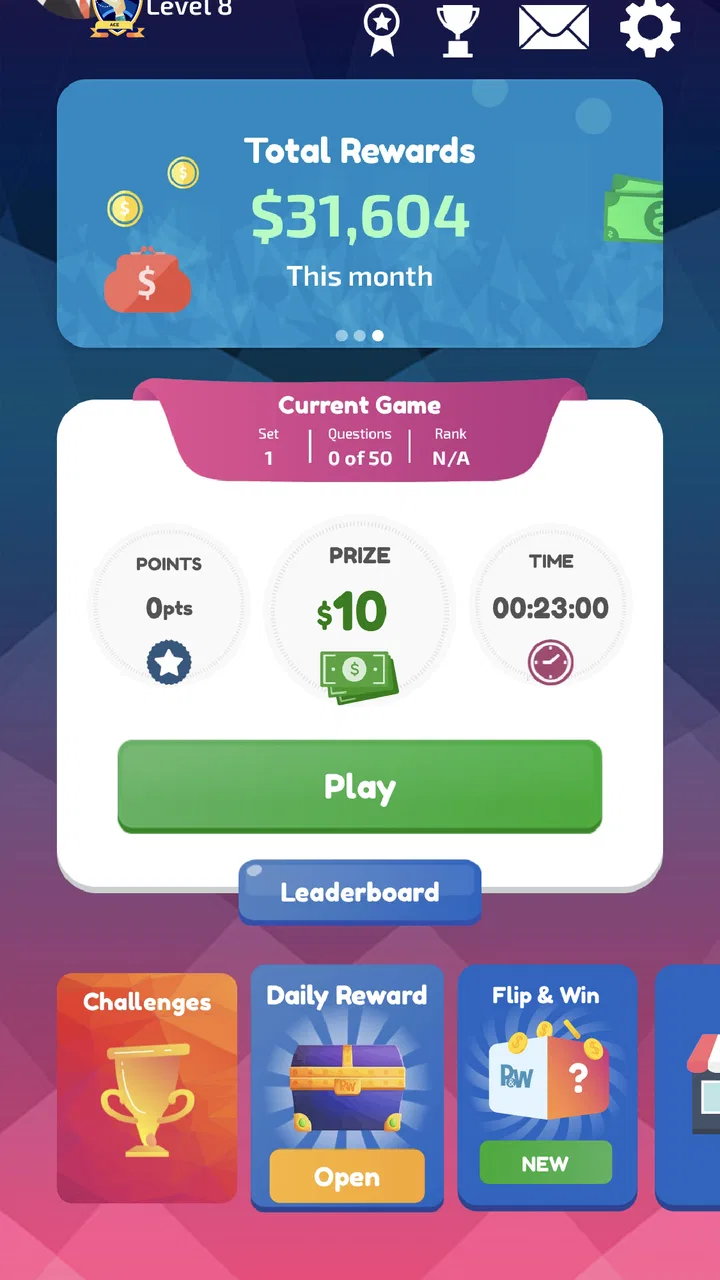
Play and Win-Win Cash Prizes! is a free trivia game from Numbase SAL Offshore that caught my attention because it turns short bursts of general-knowledge play into a points-focused competition. I approached it less like a traditional quiz app for quiet studying and more like a quick challenge I could open when I wanted something active, simple, and potentially rewarding. That distinction matters: the main appeal is not a deep lesson system, but the pressure of answering questions while trying to build the highest score.
The game is available to everyone and has passed the point of being a niche experiment, with over a million installs and an average rating of 3.5 from around eighteen thousand ratings. Those figures suggest a sizeable audience, but also a mixed experience. My impression is that its strongest quality is immediacy. You can understand the basic purpose quickly, start testing your knowledge, and decide within a few rounds whether the competitive format suits you.
Why the cash-prize trivia format changes the experience
The important capability here is the combination of trivia questions, point collection, and the possibility of cash prizes. In an ordinary quiz game, a wrong answer usually costs little beyond a lower score. Here, the idea of winning something gives each question more weight, even when the session itself is brief. I found that this changes how I read the questions: instead of casually tapping through them, I naturally slowed down enough to separate what I knew from what I was merely guessing.
You May Also Like

 Blood Strike: 2.5 Anniversary
Blood Strike’s Loadouts Turn Every Drop Into a Tactical Gamble
A close look at Blood Strike’s custom loadouts: how fast access to signature weapons reshapes its battle royale rhythm, rewards preparation, and narrows the gap between fights.

 Pandora - Music & Podcasts
Pandora’s Music Is Easy to Start, but Harder to Recover
Pandora’s strength is its low-effort path from a seed to a station. Its weak spot is how much confidence it asks you to place in connection, setup, and quiet recovery.

 8 Ball Pool
 Is Built on Rivalries, Rematches, and Routine
A close look at the rivalries, rematches, shared routines, and unanswered safety questions that turn a quick pool match into a persistent mobile community.

 Samsung Music
’s Quiet Strength Is Playing What You Already Own
Its reach comes less from spectacle than from dependable access to a personal library. That simplicity is both the app’s strongest retention engine and its ceiling.

 AccuWeather: Weather Radar
AccuWeather Review: A Quick, Clear Forecast for Everyday Decisions
For everyday plans, the best forecast is the one you can understand quickly. AccuWeather makes rain timing, radar, and local conditions easy to act on, with a few trade-offs.

 Hill Climb Racing
Why Hill Climb Racing Still Turns Crashes Into One More Run
A tiny car, a bumpy hill and one more upgrade: Hill Climb Racing keeps resurfacing because its simple chaos makes every near-miss feel personal.
More From Our News Desk



That added tension can make familiar trivia feel more involving. A question about a subject I knew well became an opportunity to protect a good run, while an unfamiliar one forced a quick decision about whether to trust my first instinct. The result is a more focused form of casual play. It is still accessible enough for a spare moment, but the prize-oriented framing gives the session a purpose beyond collecting badges or watching a score rise.
At the same time, I would not treat the cash element as the reason to install it on its own. A prize-based game has to be enjoyable before the reward matters. If you dislike general trivia, or if you only enjoy games with a clear progression system, the possibility of cash will not fix that mismatch. I see the reward angle as an extra layer over the quiz, not a substitute for good questions or a satisfying rhythm.
The game is free to download, while in-app purchases range from less than a dollar to several dollars per item. That makes it easy to try without paying at the start, but I would still approach purchases carefully. A free entry point is useful for testing the question style and overall pace; it is not a reason to assume that spending will automatically improve your results or guarantee a prize.
How a typical session feels
In practice, I found the central loop easy to grasp: answer trivia, accumulate points, and aim to finish as high as possible. That simplicity is one of the best decisions in the design. There is no need to learn a complicated control scheme, and the game does not ask me to build a character or manage a large collection before I can enjoy the quiz itself.
The most useful way to play is with a deliberate rhythm. I read the entire question first, identify the subject, and only then look at the possible answers. That small habit reduces impulsive taps, especially when two choices seem plausible. It also makes the experience feel more like a test of knowledge and less like a reflex game. When I am unsure, I choose the answer I can support rather than repeatedly changing my mind at the last second.
Players should also separate two goals that are easy to confuse. One is improving personal trivia performance; the other is pursuing a cash prize. The first is within your control because you can learn from mistakes and become better at recognizing common topics. The second depends on the competitive outcome and the rules surrounding the prize activity. Keeping those goals separate helps prevent a disappointing result from making the entire game feel pointless.
Because the game is built around points, score awareness becomes part of the enjoyment. I like that the score gives a clear reason to replay a session, but it can also make casual players chase a better result longer than they intended. My practical advice is to decide before starting whether you are playing for a quick mental break or for a serious attempt at a high score. That simple boundary keeps the competitive side from taking over an otherwise harmless pastime.
A realistic everyday use case
The best scenario for me is a short waiting period: sitting in a lobby, taking a break between tasks, or having a few minutes before leaving home. Instead of opening a social feed and losing track of time, I can play a compact trivia session with a clear beginning and end. The point system gives those spare minutes some structure, while the broad quiz format makes it possible to participate without preparing a topic in advance.
It can also work well as a light challenge between friends, even if each person plays separately. We can compare how confidently we handle the same kind of general knowledge and discuss the questions that caused trouble. I would not use it as a formal classroom tool, because the prize-focused design is aimed more at competition than teaching, but it can make a relaxed quiz night more engaging.
Another useful approach is to treat missed questions as prompts for curiosity. If I encounter a fact I did not know, I make a mental note to look it up later rather than assuming the game itself will teach the subject in depth. This turns the app into a starting point for learning without expecting it to replace a dedicated educational resource. That distinction is important for parents and students who want explanations, structured lessons, or reliable progress tracking.
The everyone age rating makes the game broadly approachable, but adults should still explain the difference between playing a free trivia game and participating in prize-oriented activities. Younger players may focus on the idea of cash without understanding the value of money or the importance of not making unnecessary purchases. I would let a child try the quiz only with suitable supervision around spending and expectations.
Where it differs from ordinary trivia alternatives
Compared with a standard offline quiz app, this game has a stronger sense of stakes because points are connected to the possibility of cash prizes. That can make even familiar questions feel more urgent. The trade-off is that a traditional quiz may be better for relaxed learning, repeated practice, or playing without thinking about rankings and rewards.
Compared with a multiplayer trivia title built around social interaction, Play and Win-Win Cash Prizes! is more attractive to someone who wants the quiz itself to remain the focus. I do not choose it when I want a rich community experience, long conversations, or a heavily themed world. I choose it when I want to test my knowledge quickly and see whether I can produce a strong score.
It also differs from puzzle games that reward long-term planning. There is no appeal here for someone looking mainly for resource management, story development, or strategic construction. Its strength is the direct question-and-answer loop. That narrow focus is useful when it matches your mood, but it limits the reasons to return if trivia is only a small part of what you usually play.
The trade-offs I noticed after repeated play
The biggest limitation is the dependence on question quality and personal knowledge. A trivia game can feel exciting when the subjects are familiar and frustrating when several questions fall outside your interests. Since the main loop is so focused, a run of questions that does not suit you has a noticeable effect on the whole session. This is not a game I would recommend to someone who needs a wide variety of mechanics to stay engaged.
The prize language also creates a trade-off between motivation and expectation. It is motivating to have more at stake than an abstract score, but it can encourage players to judge every round only by its financial outcome. I prefer to view the cash-prize possibility as a bonus and the trivia challenge as the actual entertainment. That mindset makes losses easier to accept and reduces the temptation to spend simply because a previous session did not go well.
Another point to consider is the rating. An average of 3.5 indicates that many players find something worthwhile, while others clearly encounter enough friction to lower their enthusiasm. I would not read that number as a verdict, but as a reason to try the free version before committing to regular play. The game’s basic appeal becomes clear quickly, so there is little benefit in assuming it will suit you without testing the pace yourself.
The current version is 4.01, and the game supports devices running Android 7.0 or later. That makes it accessible to many older Android phones, which is helpful for a lightweight trivia title. Still, I would make sure the device is comfortable for reading questions and tapping answers. A small or damaged screen can make a timed quiz feel harder for the wrong reason, particularly when the challenge is supposed to come from knowledge rather than awkward controls.
How to get more from each round
My first practical tip is to use a two-pass decision process. On the first pass, I identify the answer I know immediately. On the second, I revisit uncertain questions and remove options that clearly do not fit. This is more reliable than staring at every choice for the same amount of time, and it preserves mental energy for the questions that genuinely require thought.
My second tip is to avoid treating every mistake as evidence that the game is unfair or that your knowledge is poor. Trivia performance is affected by topic familiarity, wording, and pressure. I pay attention to patterns instead: do I miss geography, entertainment, science, or historical questions more often? Recognizing that pattern helps me decide whether I want to improve a weak area or simply accept that the game is testing subjects outside my strengths.
My third tip is to set a spending rule before using the app. Since purchases are available from $0.99 to $7.99 per item, I would not make an impulse purchase immediately after a disappointing score. Play enough free sessions to understand the format, then decide whether the extra option is genuinely useful to your enjoyment. If the quiz is not fun without spending, paying is unlikely to solve the underlying problem.
A fourth useful habit is to play when you are alert rather than distracted. Trivia rewards attention, and trying to answer while carrying on a conversation or rushing through a commute can produce a score that says more about your circumstances than your knowledge. A quiet break of a few minutes is a better setting than a situation where you are constantly interrupted.
Who will enjoy it most
I think the strongest audience is people who already enjoy general-knowledge quizzes and want a more competitive reason to replay them. It is especially suitable for players who like short sessions, visible scoring, and the pressure of making quick choices. The free starting point also makes it a low-risk experiment for anyone curious about prize-oriented trivia.
It is less suitable for players who want detailed explanations after every answer, a carefully structured study plan, or a purely relaxing experience without financial framing. I would also point younger users and cautious spenders toward supervised play, because the possibility of cash prizes and optional purchases can create expectations that a simple quiz cannot always satisfy.
For serious trivia fans, the game is best used alongside, rather than instead of, a deeper quiz resource. A dedicated learning app may offer better explanations, while a social trivia game may provide stronger interaction with friends. This title earns its place when I want a direct challenge built around points and the chance of a reward, not when I need a complete education platform or a broad entertainment package.
Play and Win-Win Cash Prizes! is a focused trivia game with a clear hook: it makes answering questions feel more consequential by connecting strong scores with cash-prize potential. I like the immediacy, the easy-to-understand loop, and the way a few spare minutes can become a small knowledge challenge. I also think the mixed rating and purchase options are good reasons to keep expectations realistic.
My recommendation is to install it for the quiz experience first. Try several free rounds, use a calm and deliberate answering rhythm, and decide whether the competitive atmosphere adds enjoyment rather than pressure. If you want quick general trivia with a reason to chase a higher score, this is where the game makes its strongest case. If you mainly want teaching, social depth, or a completely reward-free quiz, another option will probably serve you better.
Released on July 18, 2018, and still available in version 4.01, the game has had time to find a broad audience while keeping its central idea straightforward. In my experience, its value comes from that narrow focus: cash-prize trivia works best when the questions themselves are already fun to answer. Approach it as a quick competitive diversion, not a guaranteed income source, and it becomes much easier to judge fairly.
FAQs for Play and Win-Win Cash Prizes!
01What is Play and Win-Win Cash Prizes! and how does it work?
Play and Win-Win Cash Prizes! is an engaging mobile app available on both Android and iOS platforms that offers users the chance to participate in various games and quizzes to win cash rewards. Users can select from a variety of categories, play games, and earn points which can be redeemed for cash prizes. The app ensures a fun and interactive experience for users of all ages.
02Is Play and Win-Win Cash Prizes! free to download and use?
Yes, Play and Win-Win Cash Prizes! is free to download and use. However, the app may offer in-app purchases or advertisements to enhance the user experience. While users can enjoy most features without spending money, optional purchases might provide benefits such as additional lives or hints in games.
03Are the cash prizes real, and how can I claim them?
The cash prizes in Play and Win-Win Cash Prizes! are indeed real. Users can earn points by playing games and participating in quizzes, which can then be redeemed for cash. To claim these prizes, users typically need to reach a minimum threshold of points and follow the app's instructions for withdrawal through supported payment methods like PayPal or direct bank transfer.
04Is Play and Win-Win Cash Prizes! safe and secure to use?
Play and Win-Win Cash Prizes! prioritizes user safety and security. The app employs secure encryption to protect personal and financial information. Additionally, it regularly updates its security protocols. Users are encouraged to download the app from official app stores to ensure they are getting the legitimate and secure version of the application.
05What are the system requirements for Play and Win-Win Cash Prizes!?
Play and Win-Win Cash Prizes! requires a smartphone with Android 5.0 or later, or iOS 11.0 or later. It is recommended to have a stable internet connection to fully enjoy the interactive features and participate in live challenges. Adequate storage space is also necessary to accommodate game updates and additional content.
Pros
- Easy-to-use interface for smooth navigation.
- Engaging gameplay with diverse challenges.
- Frequent updates with new content.
- Secure transactions for cash prizes.
- Supportive community with active forums.
Cons
- Limited availability in some regions.
- Occasional ads can be intrusive.
- Requires a stable internet connection.
- Some features locked behind paywall.
- Can drain battery quickly during play.

Play and Win-Win Cash Prizes!
Gallery